We survey, design, install and audit cathodic protection systems. Choose a group to see the details.
Cathodic protection technical services
ON, native and ON/OFF potential surveys, Close Interval Survey (CIS), Direct Current Voltage Gradient (DCVG), External Corrosion Direct Assessment (ECDA), audits, soil measurements, pipe locating, tests, rectifier monitoring and data overlay.
Deep and shallow impressed current groundbeds, galvanic anode systems, rectifier installation and commissioning, recoating, corrosion coupons, test stations and maintenance of above-ground and ancillary structures.
We survey, test and audit in the field to find out whether a buried or submerged structure is protected and what needs to be corrected.
ON, native and ON/OFF potential surveys
Structure-to-soil potential at each test point, with GPS-synchronized interruption, to verify that protection meets the criterion.
Close Interval Survey (CIS)
Continuous ON/OFF potential profile, step by step along the pipeline, to locate under- or over-protection, interference and contacts.
Direct Current Voltage Gradient (DCVG)
Location of coating defects on buried pipes without excavation, classified by severity.
External Corrosion Direct Assessment (ECDA)
Four-step assessment of external corrosion, with indirect inspection, verification excavations and recommendations.
Cathodic protection system audits
Field review of a system in operation: potentials, rectifiers, anodes, isolation and documentation.
Soil resistivity and pH measurements
Resistivity by the Wenner method, by layers and in a soil box, and pH, as the basis for designing the system.
Coating defect detection and condition assessment
We assess the condition of buried pipe coatings and locate their defects with DCVG or Alternating Current Voltage Gradient (ACVG), as appropriate.
Pipe and cable locating
We locate the route and depth of buried pipes and cables with electromagnetic locators, and georeference them.
Soil and water analysis
We take samples and analyze the parameters that influence corrosion, such as chlorides, sulfates, pH and bacteria.
Current requirement tests
We inject test current with a temporary source and measure the structure’s response to calculate how much current the system needs.
Casing tests
We verify that the pipe is electrically isolated from the casing at crossings and detect contacts that reduce its protection.
Electrical isolation and insulating joint tests
Electrical isolation tests of pipes by current injection, and verification of monolithic isolating joints and insulating joints.
Potential profile
Graph of potentials along the structure from measurements at fixed points, to see how protection is distributed.
Periodic rectifier monitoring
Scheduled visits to record each rectifier’s voltage, current and condition, and adjust it if needed.
Data overlay
We align CIS, DCVG, ACVG, PCM, depth of cover and other survey data by chainage and coordinates, and overlay them on a profile sheet to see everything together and make well-founded decisions.
Engineering
We design, evaluate and commission cathodic protection systems, and define how to monitor them throughout their service life.
Cathodic protection system design
We calculate and size impressed current or galvanic anode systems from field data, with calculation report, drawings and specifications.
Evaluation, audit and commissioning
We review the engineering of a system, our own or a third party’s, before it is built. Then we commission it: energizing, rectifier adjustment and verification of the protection criterion.
Failure analysis
When a cathodic protection system stops protecting, we find the cause: rectifiers, groundbeds, anodes, isolation, contacts or interference. Then we define the correction.
Materials evaluation
We select the materials for each project, inspect those that arrive on site, and evaluate and develop new materials and suppliers.
Economic feasibility studies
We compare alternatives, such as impressed current, galvanic anodes or coating replacement, by their initial and maintenance cost over the service life.
Cathodic protection programs (development and review)
We develop or review a system’s monitoring program: what is surveyed, how often, with what criterion and how it is recorded.
Installations
We install and commission cathodic protection systems, repair coatings and maintain above-ground facilities.
Impressed current groundbeds, deep and shallow
Turnkey groundbed installation, in a deep well or in a trench, from drilling to commissioning with the rectifier.
Galvanic anode systems
Systems that need no external power. The anodes are connected to the structure and corrode in its place.
Rectifier installation and commissioning
We install the rectifier, connect it to the power supply, the groundbed and the structure, and adjust it to deliver the required current.
Recoating: coating repair and replacement
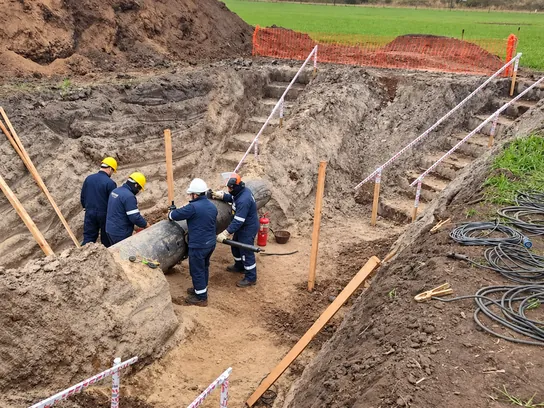
We repair or replace damaged coating on buried pipes at the points identified by inspection, with thickness and continuity testing.
Corrosion coupons
We install coupons connected to the structure. Among other data, they allow surveying the OFF potential without interrupting the system current, the current density and the corrosion rate at that point.
Test stations
We install test stations and markers, with their connection cables to the structure, to survey potentials and monitor the system.
Maintenance of above-ground and ancillary structures
We maintain everything above ground level: painting test stations and markers, replacing signs, covers and cables, and repairing gates and rectifier cabinets, among other work.
Consulting
We advise, supervise and train in cathodic protection, and analyze each system’s data to support technically sound decisions.
Product design
We design the product each client needs for cathodic protection and corrosion control.
Technical project supervision
We provide inspectors to supervise cathodic protection works: materials, installation and testing. When the project requires it, we add cathodic protection specialists in the field.
Staff training
We train technical and field teams in cathodic protection, coatings and anticorrosive paints, anywhere in Argentina: in person, in the classroom and in the field, or remotely.
Project consultations
We answer specific technical questions about a project: scope, criteria, applicable standards or tender documents.
Data review and analysis
We review the data the client already has, such as surveys, rectifier records or third-party reports, to assess how the system has evolved and what needs to be corrected.
Patrolling and gas leak detection
We patrol gas pipelines and gas facilities to detect third-party works and leaks early, and notify the operator immediately.
Pipeline patrolling
We patrol the gas pipeline route to detect works, construction and third-party activity in the safety strip early, and give immediate notice when there is a risk.
Gas leak detection
We survey gas pipelines, urban networks and gas facilities with a portable detector to locate leaks, and record each one with its location.
Not sure which service you need?
Tell us what structure you have and we’ll propose the scope.