

Direct Current Voltage Gradient (DCVG)
We locate coating defects on buried pipes without excavation and classify them by severity to decide where to repair first.
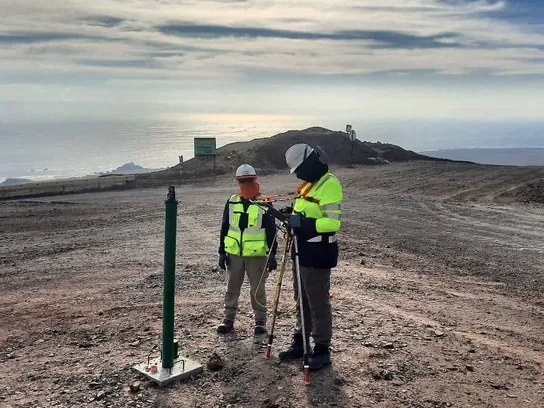
What it is
The Direct Current Voltage Gradient (DCVG) detects defects in the coating of buried pipes. With the protection current switched on and off in cycles, the potential gradient in the soil is measured between two electrodes. Where there is a defect, the current entering the pipe creates a gradient that allows it to be located and its severity estimated as a percentage of IR (%IR).
When it is needed
- To assess the coating condition of a buried pipe.
- As indirect inspection within an External Corrosion Direct Assessment (ECDA), together with the Close Interval Survey (CIS).
- When the CIS or the potential survey shows localized drops.
- Before a repair or recoating program, to prioritize excavations.
How we do it
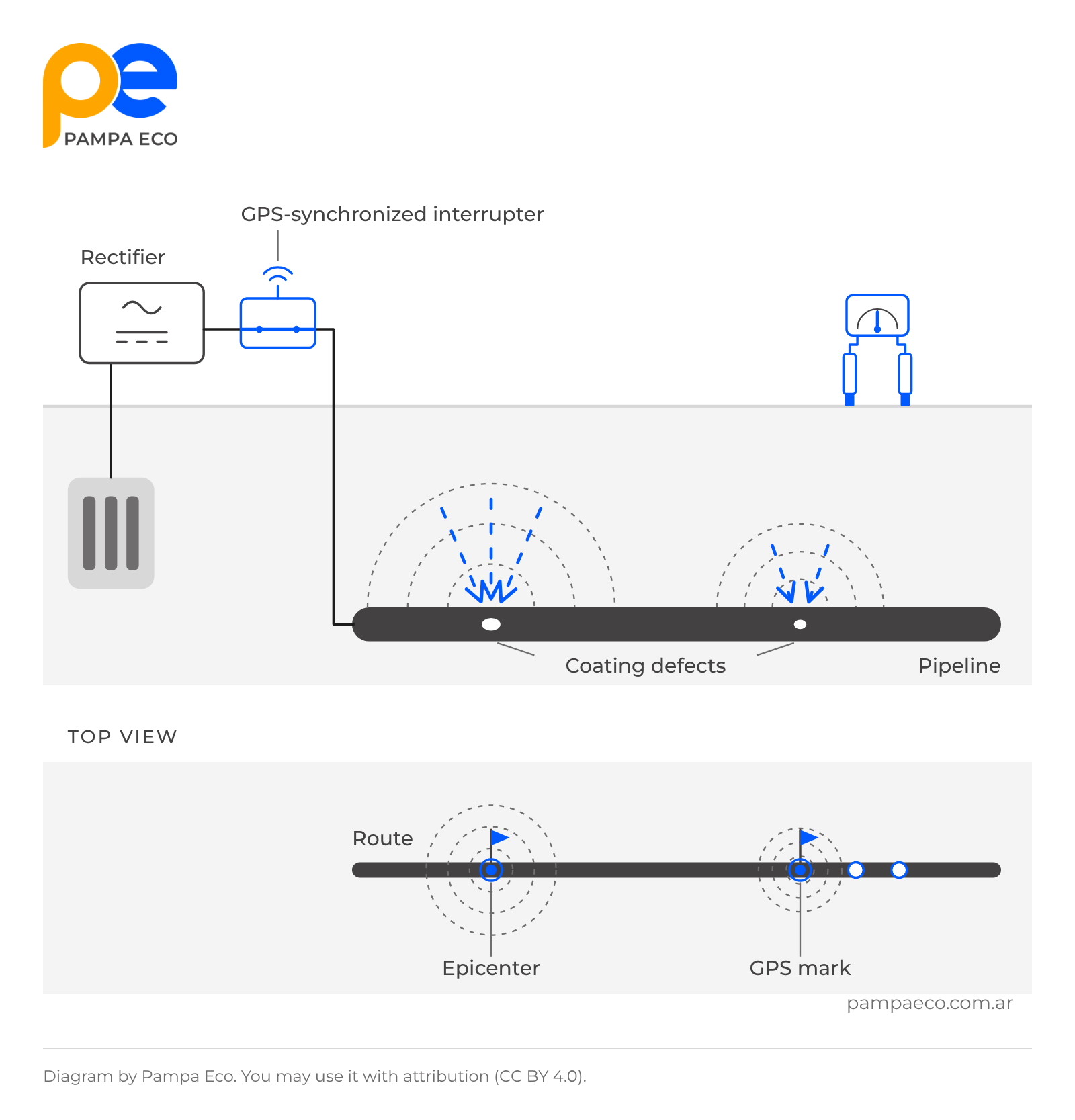
Diagram by Pampa Eco. You may use it with attribution (CC BY 4.0).
We install GPS-synchronized interrupters on the rectifiers, anodes or current injection points that influence the section.
We locate the pipeline route with a pipe locator.
We walk the route step by step with two Cu/CuSO4 electrodes and measure the gradient in the soil.
At each indication we locate the epicenter, measure the %IR and classify it by severity.
We mark and georeference each defect with sub-meter GPS.
If there is no impressed current system, we use a temporary source.
Equipment
- DCVG instrument
- Cu/CuSO4 reference electrodes
- GPS-synchronized current interrupters
- Pipe locator
- Sub-meter GPS
Deliverables
- List of defects with chainage, coordinates, %IR and severity.
- Excavation prioritization.
- Georeferenced KMZ file.
- Final report in PDF.
- Instrument calibration certificates and personnel certifications.
Standards
NACE SP0207 – NACE SP0502 – NACE SP0169
Where we apply it
Pipelines – Industrial plants – Service stations and fuel depots